
Matt Pratt-Hyatt
Chief Science Officer, KBMO

Toxin Exposure – A Daily Detoxification Challenge
We are all constantly bombarded with chemicals and toxins daily. These include pesticides, herbicides, household products, microbes such as bacteria and mold, vehicle exhaust fumes, pollutants from industrial production, and many more. Our bodies must process these toxins so that the they become less damaging, and are removed as quickly as possible.
Toxins enter the body through three main routes: inhalation, ingestion, and skin contact (1). The body processes and detoxifies them through two ‘phases’ of detoxification, known as phase 1 and phase 2.
Phase 1 Detoxification: Involves the direct modification of toxic molecules by enzymes in the body. The most prevalent phase 1 enzymes are the cytochrome P450 enzymes (2).
Phase 2 Detoxification: Phase 2 involves the addition of a substance (such as cysteine) to a toxic molecule, in order to make it more water soluble and generally less toxic (3). One of the most common phase 2 processes is the addition of glutathione, also known as the body’s ‘master antioxidant’. Glutathione forms new compounds that originate from inside and outside the body.
Detoxification Markers and the MIP Organic Acids Test
The MIP Test helps to determine how well (or otherwise) the body is detoxifying, via the following markers:
Pyroglutamic acid: One of the most common causes of the buildup of pyroglutamic acid is depletion of glutathione. This usually indicates an exposure to toxins (4). Other causes of elevated pyroglutamic acid include liver disease, sepsis, and malnutrition (5).
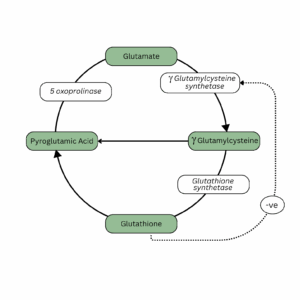
2-Hydroxybutyric: Another marker that is important in this pathway. This is a byproduct of glutathione synthesis, thus increased demand for glutathione could lead to an increase of 2-HB in urine(6).
8-Hydroxy-2-deoxyguanosine (8-OHdG): Another pathway that measures oxidative stress. This is produced when guanine bases are subjected to oxidative damage, and this marker is positively correlated with inflammation. Toxin exposure could lead to increased amounts of 8-OHdG (7).
Want to Learn More?
If you’re interested in learning more about how organic acids can provide insights into detoxification processes and challenges in your patients, please contact us here.
The KBMO Diagnostics Metabolics Insights Profile (MIP) provides a full metabolic snapshot for your patients, including markers that can reveal issues such as nutritional deficiencies, microbial overgrowth, toxic exposure, oxalates, mitochondrial impairment, neurotransmitter imbalances and much more.
References:
- M. Tudi et al., Exposure Routes and Health Risks Associated with Pesticide Application. Toxics 10 (2022).
- O. A. Almazroo, M. K. Miah, R. Venkataramanan, Drug Metabolism in the Liver. Clin Liver Dis 21, 1-20 (2017).
- Y. Liu, A. S. Hyde, M. A. Simpson, J. J. Barycki, Emerging regulatory paradigms in glutathione metabolism. Adv Cancer Res 122, 69-101 (2014).
- S. S. Venkataraman, R. Regone, H. M. Ammar, R. R. Govindu, Pyroglutamic Acidemia: An Underrecognized and Underdiagnosed Cause of High Anion Gap Metabolic Acidosis – A Case Report and Review of Literature. Cureus 11, e5229 (2019).
- C. Persaud, T. Forrester, A. A. Jackson, Urinary excretion of 5-L-oxoproline (pyroglutamic acid) is increased during recovery from severe childhood malnutrition and responds to supplemental glycine. J Nutr 126, 2823-2830 (1996).
- B. Dorcely et al., Novel biomarkers for prediabetes, diabetes, and associated complications. Diabetes Metab Syndr Obes 10, 345-361 (2017).
- H. Arab, S. Mahjoub, K. Hajian-Tilaki, M. Moghadasi, The effect of green tea consumption on oxidative stress markers and cognitive function in patients with Alzheimer’s disease: A prospective intervention study. Caspian J Intern Med 7, 188-194 (2016).